Club Tracker is an all-in-one platform for discovering, joining, and managing clubs. After a 3-year pilot at Lakeside School (450+ students, 2,700+ annual sign-ups), I redesigned it from the ground up for a university-scale relaunch in 2025. But this case study is about more than building — it’s about failing, learning, and pivoting.

Project Description
User research study uncovering behavioral patterns in club management at U.S. high schools and universities.
Team
Katherine Sullivan
Role
Product Designer
Product Manager
User Researcher
Software Developer
Product Manager
User Researcher
Software Developer
Duration
May 2020-June 2023
Jan 2025-Present
Jan 2025-Present
About
Background
Problem
Student clubs are at the heart of campus life, but most tools are fragmented and outdated. Discovery happens at chaotic club fairs. Sign-ups vanish into unmonitored spreadsheets. Leaders are left juggling Discord, email, and reminders. Admins lack transparency and oversight.
Opportunity
There is a clear need for a centralized platform that supports:
- Students — with discovery tools, event follow-ups, and ongoing club connection
- Club Leaders — with integrated member management, announcements, and engagement tracking
- Admins — with transparency into verified clubs, attendance, and campus-wide trends
The real opportunity is not just digitizing sign-ups — it's creating infrastructure for sustained community involvement, backed by data and designed to reduce churn, friction, and disorganization at every level.
Context
MVP to Traction
Club Tracker began as a lightweight tool to streamline club discovery and sign-ups at Lakeside School. Between 2020 and 2023, the product scaled from an MVP to a campus-wide platform used by 450+ students at my high school annually, supporting over 2,700 club sign-ups across 70+ organizations. The user base tripled over three years, and freshmen consistently drove the highest adoption rates.
Silent Launch to Strategic Pivot
After graduating, I retired the high school version and began preparing Club Tracker for a university-scale relaunch. I spent summer 2025 rebuilding the product with a small team of developers, redesigning core features for sign-up, leader management, and admin oversight.
But when I demoed it to 5 Stanford organizations in fall 2025, every org ghosted before launch.
Instead of pushing a product that wasn’t ready, I paused and shifted into full discovery mode — interviewing 25+ club leaders and stakeholders across Stanford to uncover the real engagement problems we needed to solve next.
But when I demoed it to 5 Stanford organizations in fall 2025, every org ghosted before launch.
Instead of pushing a product that wasn’t ready, I paused and shifted into full discovery mode — interviewing 25+ club leaders and stakeholders across Stanford to uncover the real engagement problems we needed to solve next.
.png)
Challenge
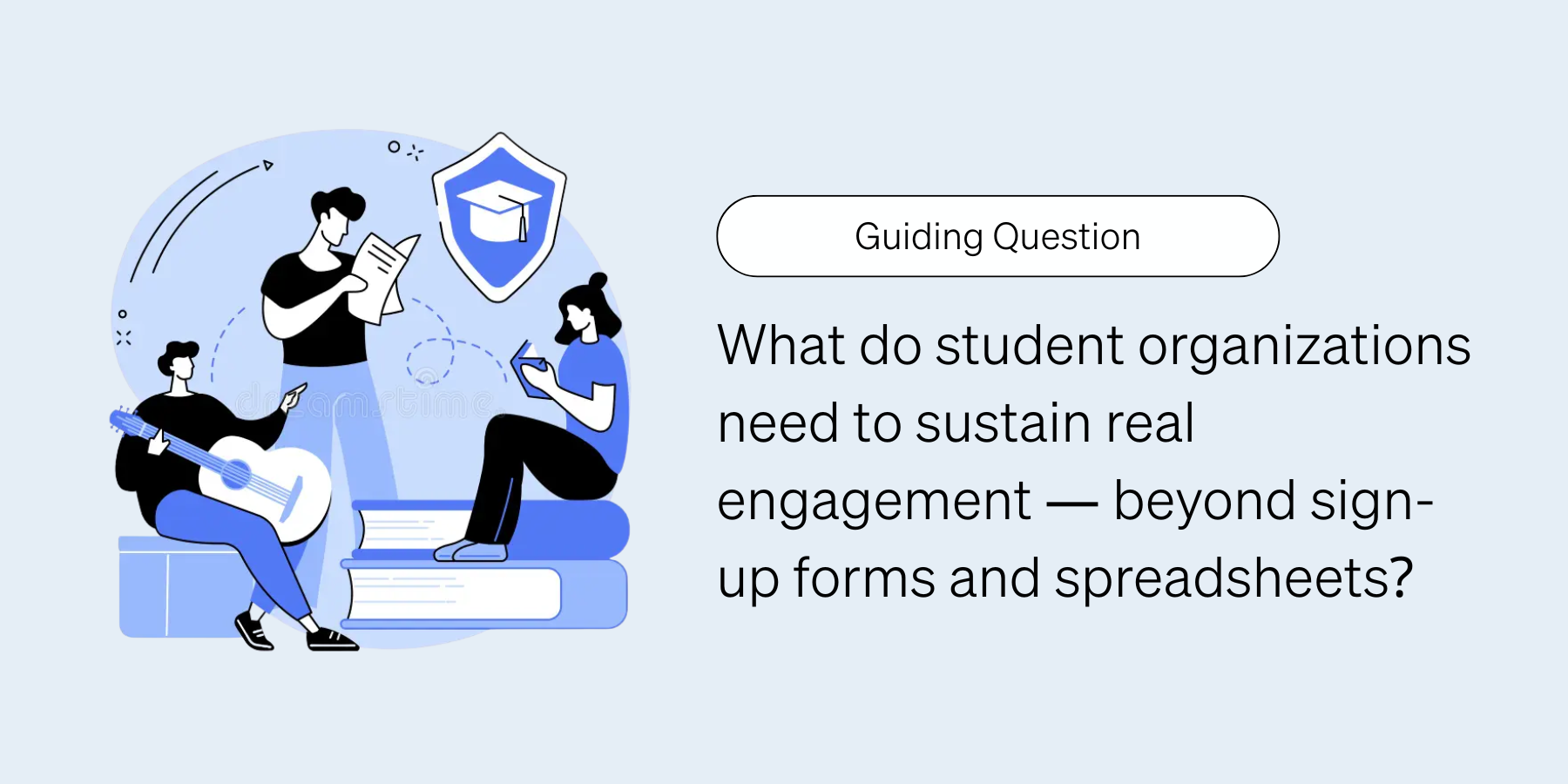
After the failed V1 launch, I paused development and interviewed 35+ club leaders and stakeholders. This guiding question emerged from that discovery process — and now shapes the product direction for Club Tracker’s university-scale redesign.
Interviews
Research Methodology
I conducted 35+ individual interviews with participants across three core groups: club leaders, student members, and an administrator responsible for student organization oversight. The majority of participants were club leaders, many of whom were also active members of other student organizations, which provided insight into both organizational and participant perspectives.
Participants were recruited based on varying roles, levels of involvement, and organizational size, ranging from small social clubs to large pre-professional organizations. While the primary focus was on understanding club leadership workflows, goals, and pain points, the diversity of perspectives contributed to a broader view of how students engage with clubs at different levels.
Interviews were semi-structured and open-ended, designed to explore current tools, communication practices, engagement patterns, and decision-making processes around recruitment and retention.
Participants were recruited based on varying roles, levels of involvement, and organizational size, ranging from small social clubs to large pre-professional organizations. While the primary focus was on understanding club leadership workflows, goals, and pain points, the diversity of perspectives contributed to a broader view of how students engage with clubs at different levels.
Interviews were semi-structured and open-ended, designed to explore current tools, communication practices, engagement patterns, and decision-making processes around recruitment and retention.
Goal
I designed this research sprint to answer three core questions:
- What are the underlying blockers to sustained club engagement — beyond discovery and sign-up?
- Where do existing tools (Sheets, Forms, Discord, etc.) fall short — and why do leaders stick with them anyway?
- What would actually motivate club leaders, students, and admins to switch platforms — and stay?
Personas
- Club Leader – Manages events and members across messy, disconnected tools
- Student Member – Joins casually, drops off quickly, overwhelmed by messages
- Administrator – Needs standardization and visibility across all clubs.
Biography
Usually a sophomore to senior, deeply involved in a specific interest area (CS, culture, service, etc.). Often juggling multiple commitments—classes, internships, other orgs. Might be an elected officer or a founder of a new organization. Uses Slack, email, GroupMe, and Google Sheets to coordinate club meetings and events.
Goals
- Grow club visibility and membership
- Plan smooth events with high turnoutImprove operations and handoffs (esp. with turnover)
- Get recognized by administration or funding organizations
Needs
- A sense of control and clarity across meetings, events, and transitions
- Confidence that critical info won’t be lost during officer handoffs
- To reduce micromanagement and manual follow-up
- Evidence that their efforts are building lasting organizational impact, not just short-term wins
- Ways to delegate without feeling like they’re dropping the ball
Pain Points
- Friction coordinating across platforms (Slack, email, Sheets)
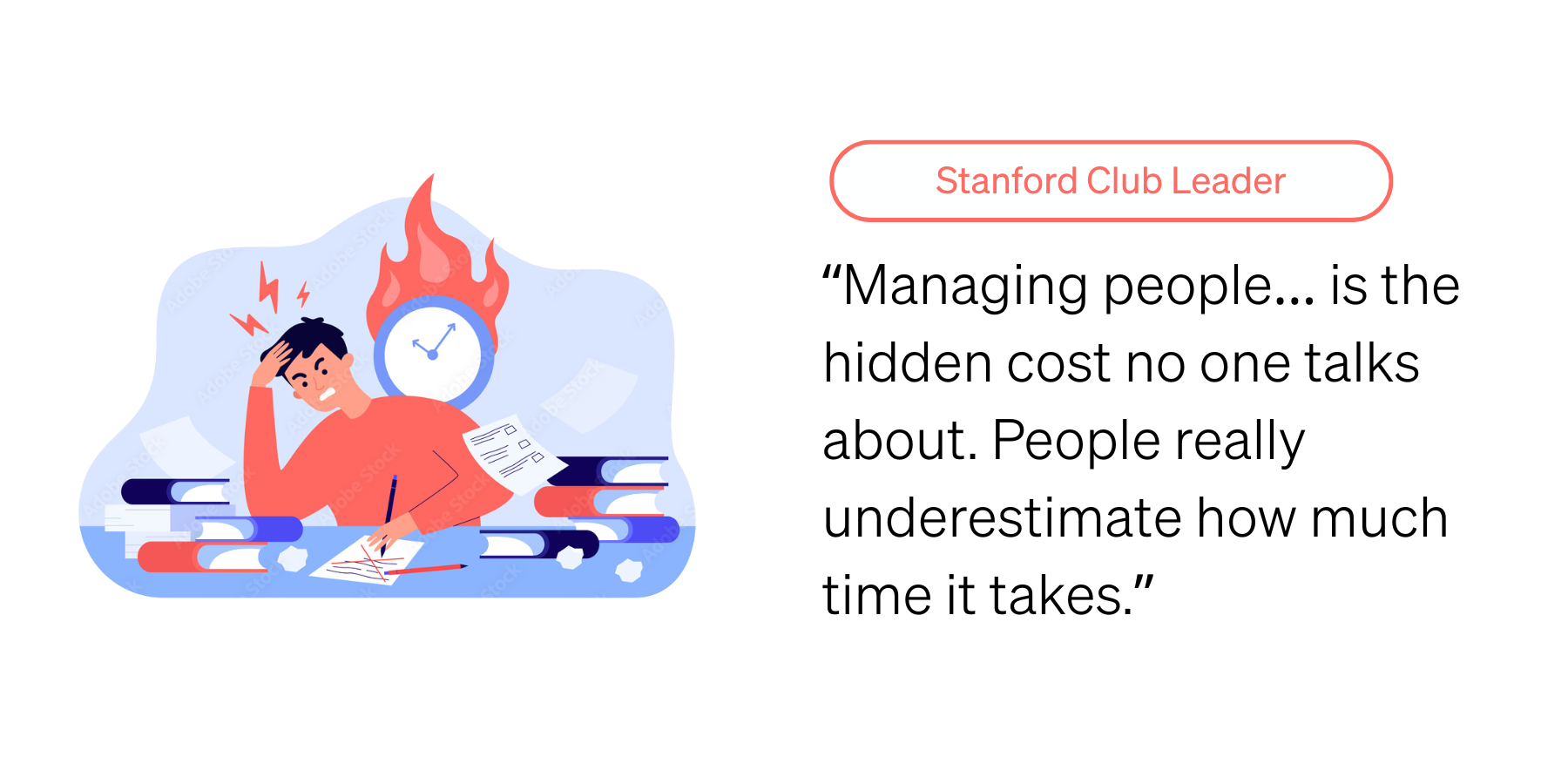
- Burnout from repetitive logistics tasks
- Recruitment chaos (e.g. people sign up, never show); difficult to keep track of prospective members
- Difficult to measure engagement or track involvement over time
- Stressful transitions when leadership changes — no continuity
.png)
Biography
Freshman to junior exploring interests or looking to deepen one. May be part of 3–5 clubs, but only actively participates in 1–2. May hold an officer role in 1 or more clubs. Finds clubs through friends, club fair, or mailing lists.
Goals
- Discover communities that match identity/interests
- Make friends and feel socially connected
- Develop skills or gain experience through participation
- Minimize hassle — easy to join, show up, and get value
Needs
- Clear visibility into what clubs are active, how to join, and what events are happening
- Easy access to relevant events that feel worth showing up for
- Belonging without needing to decode where things happen or who to ask
- Quiet reassurance that their participation is valued, even if inconsistent
- Clarity on how to get more involved without feeling overwhelmed
Pain Points
- Not knowing how or when to get involved
- Club meetings that feel unstructured
- Too many communication channels (missed messages)
- Forgetting to go to events they signed up for
- Feeling overlooked or unimportant in large groups
.png)
Biography
University employee tasked with overseeing student engagement, space logistics, and policy enforcement. Wants to empower student life, but is often bottlenecked by inefficient processes and unclear communication from clubs.
Goals
- Ensure events run smoothly and meet campus policy
- Support student leadership without hand-holding
- Maintain a positive, organized flow of student activity
- Prevent last-minute scrambles and liability issues
Needs
- Confidence that clubs are compliant, prepared, and communicative
- Faster coordination on logistics like rooms, vendors, and policies
- Visibility into active vs. inactive orgs without constant nudging
- Trust that student leaders are organized and won’t create avoidable hazards to manage
- Reduce back-and-forth — greater student autonomy
Pain Points
- Receiving incomplete or last-minute requests
- Confusion over who the current club leaders are
- Needing to approve dozens of room bookings manually
- Lack of visibility into event attendance or outcomes
- Student clubs ghosting after being approved
Takeaways
Key Insights
To extract key insights, I conducted user interviews and synthesized findings through empathy maps, POV statements, and How Might We questions to articulate user needs and design opportunities. I then applied theme encoding and clustering techniques to identify patterns in the data, using mindmapping to surface interconnections and guide product direction.
Takeaway 1: Leaders chase emotional clarity, not just output
Across clubs, leaders spend more time managing silence than strategy — chasing responses, resolving tension, or mentally tracking progress when tools don’t. The true blocker isn’t communication volume — it’s the absence of clarity, confirmation, and shared accountability.
Takeaway 2: Disjointed systems create invisible burnout
Leaders rely on 5+ tools to run orgs, but these systems don’t communicate with each other. This results in lag, duplicate effort, and leaders chronically second-guessing whether they’re previously completed tasks. Fragmentation turns leadership into logistics — even in high-functioning, technically savvy teams.
Takeaway 3: Strong structure ≠ smooth execution
Clubs with polished onboarding, defined roles, and formal operation teams still struggle. Why? Because leadership handoff and role clarity break down without proactive systems for expectation-setting, timeline visibility, and nudges. Surprisingly, the maturity of the organization does not guarantee execution if members’ accountability to complete tasks is manually-driven.
Takeaway 4: The real need is trust without micromanagement and time-draining logistics
Whether running a social club or engineering a car, leaders want to lead — not micromanage. The dream isn’t fewer tools; it’s fewer doubts. When a system verifies what’s happening and who’s accountable while reducing cognitive load, leaders get to step back and actually lead.
Reflection
What did I learn working on this project?
Building and relaunching Club Tracker taught me what it truly means to ship end-to-end — not just code, but vision. I wore every hat: product strategist, visual designer, researcher, software engineer, and founder. I learned how to conduct scrappy but meaningful user research, translate insights into features, prioritize a roadmap, and balance what users want with what’s feasible. I iterated on flows, redesigned interfaces, and made countless tradeoffs under pressure.
I also learned the power (and vulnerability) of launching in public. Every decision had visibility. But the feedback — both good and brutal — made the product better. It taught me that iteration isn’t just a phase; it’s a mindset. More than anything, this project cemented my belief that great products are born at the intersection of deep user empathy and relentless iteration.
I also learned the power (and vulnerability) of launching in public. Every decision had visibility. But the feedback — both good and brutal — made the product better. It taught me that iteration isn’t just a phase; it’s a mindset. More than anything, this project cemented my belief that great products are born at the intersection of deep user empathy and relentless iteration.
What would I have done differently?
After running Club Tracker at Lakeside for 3 years, I assumed many of the same pain points would translate directly to a university environment. In retrospect, I would have taken more time between launches to conduct focused user interviews with college club leaders and admins.
While my early insights gave me a strong foundation, skipping this step meant I entered the Stanford rollout with assumptions that didn’t fully account for the scale, structure, and fragmentation of university club ecosystems. I’ve learned that even when a problem feels familiar, the surrounding context can redefine it entirely — and validating those nuances early saves critical time down the line.
While my early insights gave me a strong foundation, skipping this step meant I entered the Stanford rollout with assumptions that didn’t fully account for the scale, structure, and fragmentation of university club ecosystems. I’ve learned that even when a problem feels familiar, the surrounding context can redefine it entirely — and validating those nuances early saves critical time down the line.
How has this experience prepared me for my next project?
This project strengthened my skills in:
- End-to-end product development — from MVP to public rollout
- User-centered iteration — through direct interviews and field testing
- Product strategy — balancing vision, scope, and constraints
- Cross-skill execution — working across design, research, and engineering
- Iteration — recognizing when something isn’t working and resetting with clarity
I’m leaving this experience with sharper instincts, stronger technical and design fluency, and a deeper respect for how much intention and resilience it takes to build something that lasts. My next project won’t just start faster — it will be smarter from the start.