Duolingo has successfully redefined language learning by prioritizing accessibility, gamification, and daily habit formation. Through streaks, XP systems, and low-friction onboarding, the platform drives strong early engagement across a wide global user base.
However, sustained learning depth and long-term progression may require additional structural support as learners advance beyond foundational content.

Project Description
Product strategy deep dive analyzing Duolingo’s retention gaps and proposing high-impact feature investments to drive long-term learning consistency.
Team
Katherine Sullivan
Role
Product Strategist
Duration
Jan - Feb 2025
About
Background
Problem
While the platform effectively builds daily learning habits, user research and analysis revealed several areas where long-term progression may encounter friction.
- Depth of mastery at advanced levels
- Sustained engagement beyond streak motivation
- Real-world skill application and transfer
The objective is not to replace the current gamification structure — but to deepen it with meaningful real-world integrations.
Opportunity
Rather than increasing friction or adding complexity, the highest-leverage opportunity lies in strengthening real-world language transfer for medium-usage learners.
By helping users apply what they learn in authentic, open-ended contexts, Duolingo can evolve from a habit-building platform into a mastery-building platform — improving long-term retention without compromising accessibility.
- Real-world scenario integration
- Transferable skill reinforcement
- Context-rich application experiences
The objective is not to replace the current gamification structure — but to deepen it with meaningful real-world integrations.
Strategic Direction
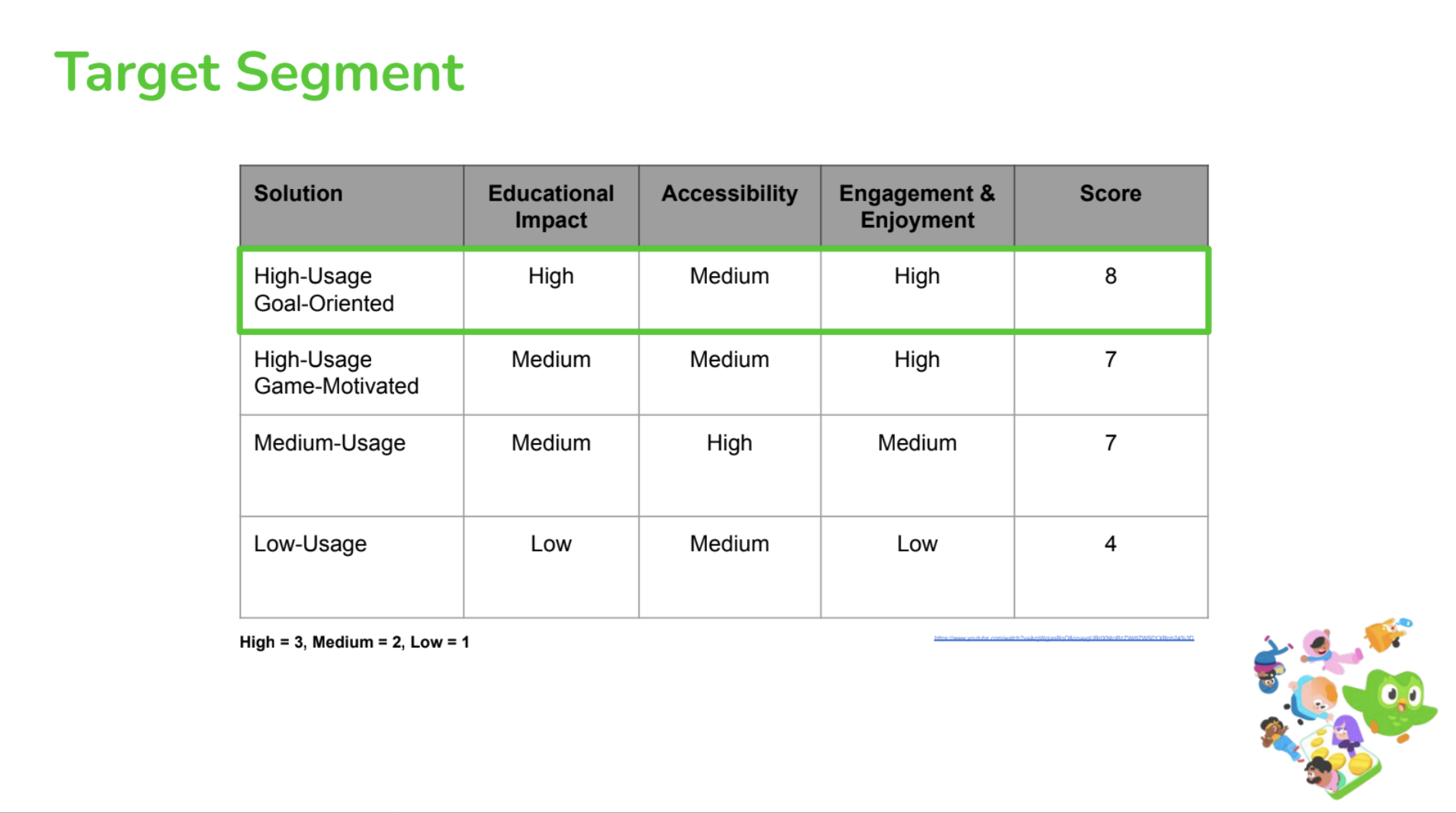
To determine where real-world integration would create the highest impact, I evaluated user segments across educational impact, accessibility, and engagement potential. High-Usage, Goal-Oriented learners scored highest across weighted criteria. These users are already committed to progression and motivated by real outcomes (fluency, career, academic success), making them highly responsive to deeper mastery features. Rather than focusing on casual or streak-driven learners, the strategy prioritizes enhancing real-world skill transfer for committed users seeking measurable progress. This direction informed the solution concepts and prioritization framework outlined below.
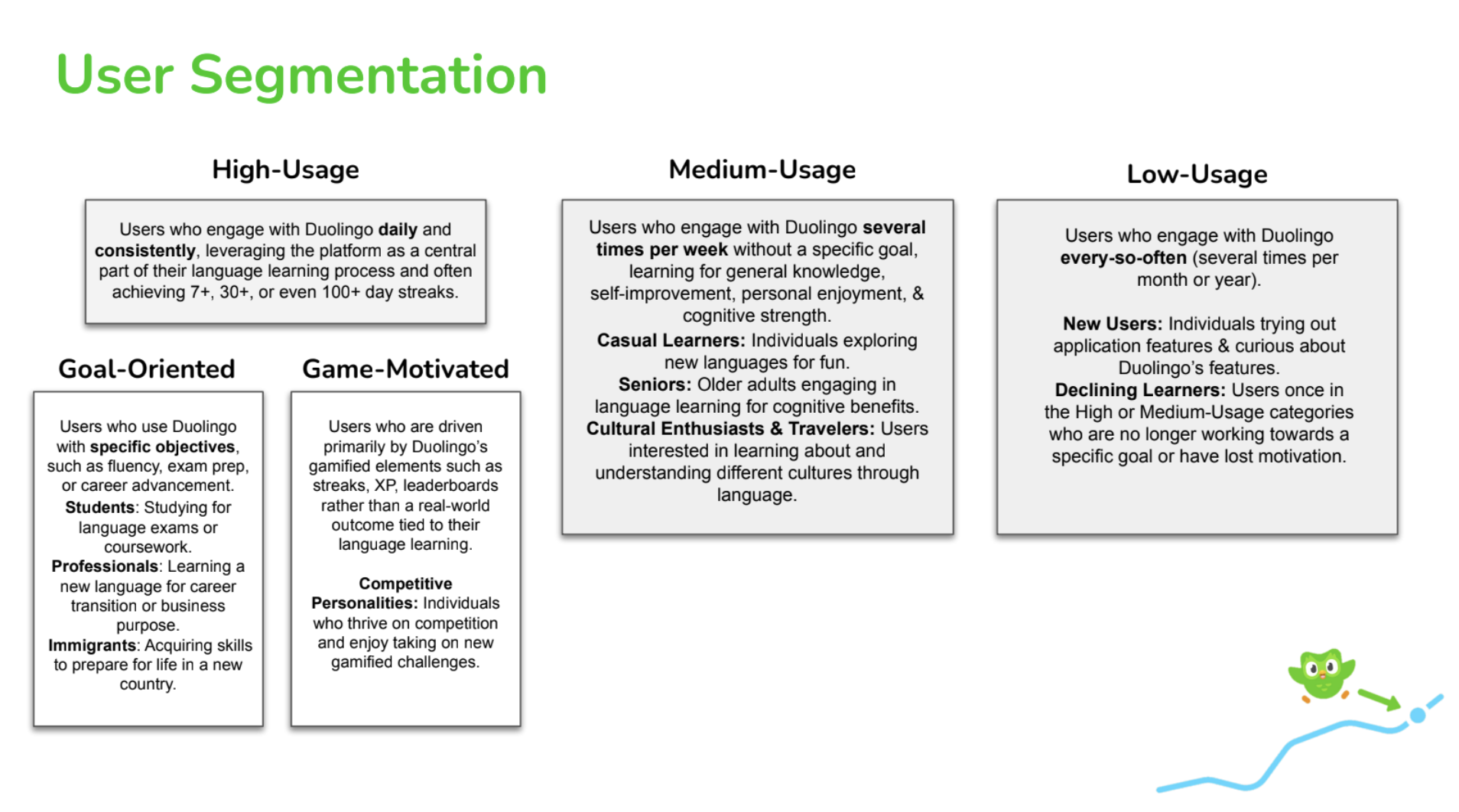
Left: User segmentation across behavioral and motivation profiles.
Right: Impact-based evaluation identifying High-Usage, Goal-Oriented learners as the primary strategic focus.
Right: Impact-based evaluation identifying High-Usage, Goal-Oriented learners as the primary strategic focus.
.png)
Full Analysis
📊 View Full Strategy and Solution Framework →
Reflection
What did I learn working on this project?
This project strengthened my ability to move from surface-level critique to structured product strategy. Instead of jumping directly into features, I learned to anchor decisions in segmentation, mission alignment, and measurable impact. Evaluating tradeoffs across educational quality, engagement, and accessibility forced me to think in terms of leverage rather than novelty.
I also learned the importance of defining metrics before solutions (shown in slides). Clarifying how success would be measured (adoption, retention, progression rates) made the strategic direction more disciplined and defensible.
I also learned the importance of defining metrics before solutions (shown in slides). Clarifying how success would be measured (adoption, retention, progression rates) made the strategic direction more disciplined and defensible.
What would I have done differently?
If I were to extend this work, I would incorporate primary user research — particularly interviews with high-usage, goal-oriented learners — to validate assumptions around real-world transfer friction. While this critique relied on secondary research due to course scope, direct qualitative insights would strengthen prioritization confidence.
I would also expand the solution into more detailed experience flows. The strategic direction was clear, but deeper interaction design and onboarding mapping would better pressure-test complexity, feasibility, and feature discoverability.
I would also expand the solution into more detailed experience flows. The strategic direction was clear, but deeper interaction design and onboarding mapping would better pressure-test complexity, feasibility, and feature discoverability.
How has this experience prepared me for my next project?
This experience sharpened how I approach product ambiguity. I now prioritize:
- User segmentation and prioritization before ideating
- Aligning solutions with mission-based metrics
- Defining measurable outcomes before ideating
Most importantly, I learned to critique without dismantling — to evolve a product’s strengths rather than replace them. That mindset will shape how I approach future product design and strategy work.