Teen social life today exists in a paradox. Teenagers are constantly connected through group chats, Snapchat, and Instagram — yet spontaneous, in-person hangouts often fail to materialize. Despite high digital interaction, coordination friction remains surprisingly high.
Kickback emerged from extensive early research, including 50+ user interviews, revealing that teens frequently want to hang out but struggle to take initiative. Planning a meetup requires someone to lead, coordinate availability, and push through group chat inertia — a social burden many teens are reluctant to carry.
The app was built to function as an “outgoing friend” — reducing the friction of planning and lowering the psychological barrier to initiating real-world connection.

Project Description
Kickback is a teen social app designed to act as an outgoing friend — suggesting activities, surfacing real-time availability, and making it effortless to turn “we should hang” into tangible plans.
Team
Darrow Hartman
Russell Ross
Boldizsar Szabo
John Young
Russell Ross
Boldizsar Szabo
John Young
Role
Product Designer
User Researcher
User Researcher
Duration
Nov. 2021 - May 2023
About
Background
Problem
Through user interviews and market research, three consistent pain points surfaced:
First, lack of initiative. Many teens described scenarios where everyone expressed interest in hanging out, but no one stepped up to organize it. Group chats became passive spaces filled with “we should hang soon” messages that never turned into action.
Second, coordination friction. Teens wanted real-time visibility into who was free at any given moment. Without this, planning required excessive back-and-forth messaging and uncertainty.
Third, trust and exclusivity. Users expressed discomfort with open social networks and preferred invite-only spaces that felt private and socially safe.
The core problem was not lack of desire for connection — it was the cognitive and social effort required to initiate and coordinate it.
First, lack of initiative. Many teens described scenarios where everyone expressed interest in hanging out, but no one stepped up to organize it. Group chats became passive spaces filled with “we should hang soon” messages that never turned into action.
Second, coordination friction. Teens wanted real-time visibility into who was free at any given moment. Without this, planning required excessive back-and-forth messaging and uncertainty.
Third, trust and exclusivity. Users expressed discomfort with open social networks and preferred invite-only spaces that felt private and socially safe.
The core problem was not lack of desire for connection — it was the cognitive and social effort required to initiate and coordinate it.
Opportunity
The opportunity was to design a system that reduced both logistical and psychological friction in teen social planning.
Instead of asking users to manually coordinate hangouts, Kickback served as a proactive social catalyst. Through surfacing nearby friends, displaying real-time availability, and suggesting activities, the app removed the need for one person to carry out logistical burden or planning. This created an opportunity to:
- Shift teens from passive group chat stagnation to active planning
- Make spontaneous hangouts easier and lower-effort
- Build a trusted, invite-only network that felt exclusive and safe
Rather than replacing existing messaging platforms, Kickback aimed to layer structure and action on top of existing social relationships.
Challenge
.png)
Interviews
Research Methodology
We conducted 50+ interviews with teens from local high schools in the Seattle area to understand how they currently plan hangouts and where coordination breaks down. We focused on uncovering social hesitation, initiative imbalance, and logistical friction within group chats. Insights were synthesized into core themes that directly informed Kickback's feature set and primary user personas.
Goal
Our research was designed to answer several key questions:
- What social barriers keep teens from initiating hangouts? We wanted to understand why group chats often fail to translate into real outings.
- What logistical pain points make planning effortful? We sought to uncover specific coordination frictions like availability uncertainty, indecision, and scheduling conflicts.
- What motivates teens socially? By exploring how teens perceive connection, spontaneity, and social initiative, we aimed to identify opportunities for a product to support — not disrupt — their social worlds.
Personas
- The Passive Planner
- The Social Hub
Biography
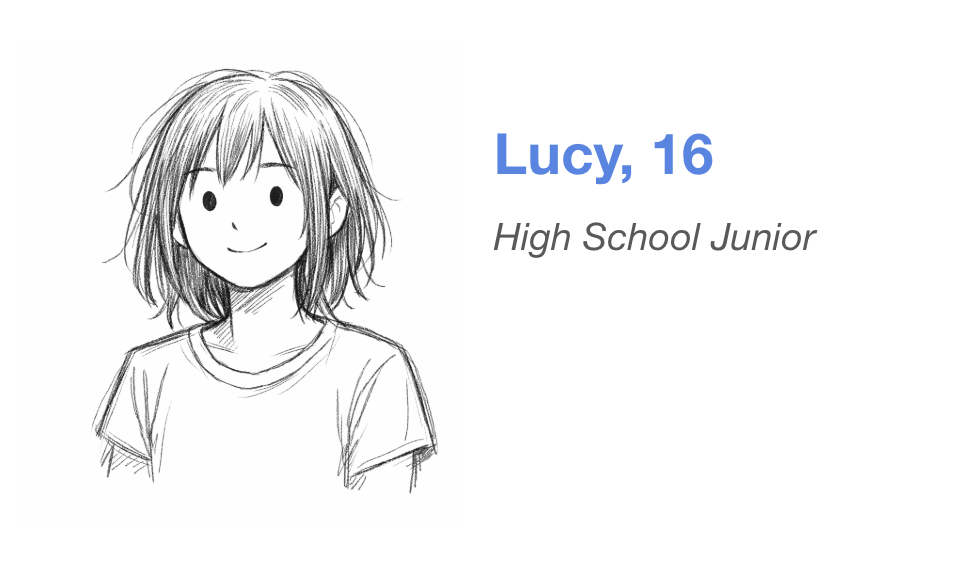
Lucy is a 16-year-old high school junior who is highly social online but rarely initiates hangouts. She is active in multiple group chats and often says “we should hang soon,” but rarely takes the lead in organizing plans. She enjoys spontaneous outings but feels awkward being the one to coordinate.
Goals
- Spend more time with friends in real life
- Avoid the awkwardness of initiating plans
- Make spontaneous hangouts feel natural
- Feel included without overexerting social effort
Needs
- Visibility into which friends are free in real time
- Low-pressure ways to suggest activities
- A socially safe digital environment
- Simple logistic coordination
Pain Points
- Group chats stall with no clear organizer
- Fear of being ignored when suggesting plans
- Overthinking logistics (when, who is available, location)
- Doesn't want to appear too eager
Biography
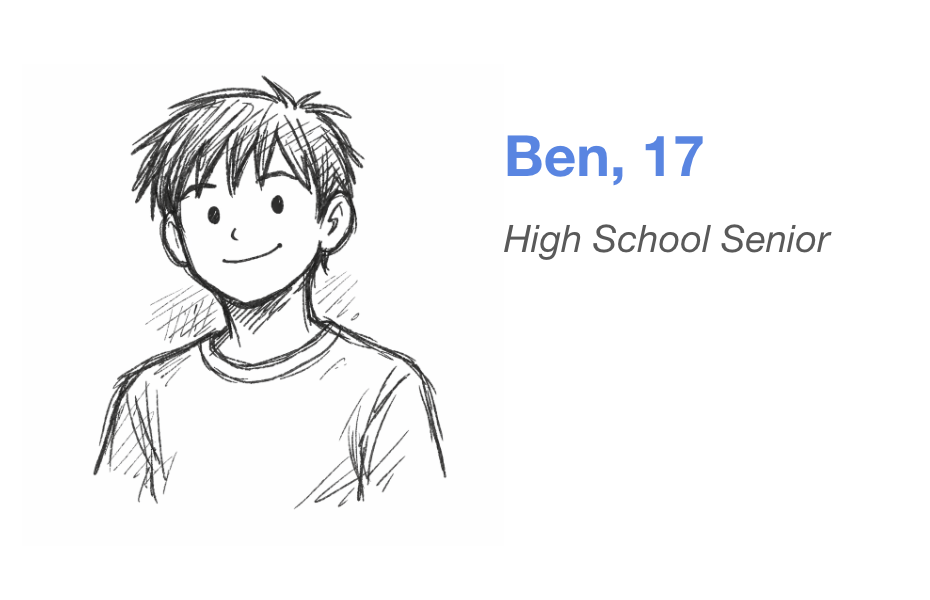
Ben is a 17-year-old senior who is well-connected and often the default planner in friend groups. He enjoys bringing people together but sometimes feels burdened by always having to coordinate logistics. He values efficiency and spontaneity.
Goals
- Make planning faster and less mentally draining
- Bring multiple friends together easily
- Avoid endless scheduling back-and-forth
- Maintain a strong, trusted social circle
Needs
- Clear visibility into who is available
- Quick scheduling
- A safe digital environment that promotes authentic connection
Pain Points
- Always ends up leading coordination efforts
- Frustrated by group chat indecision
- Wastes time figuring out availability and logistics
Takeaways
Key Insights
From our interviews, we identified three recurring behavioral patterns that shaped how teens approach social planning.
Takeaway 1: Lack of Initiative in Planning
Although teens frequently expressed interest in spending time together, group chats often stalled because no one wanted to assume the social burden of organizing plans. Initiating a hangout required choosing a time, place, and activity — and risking silence or rejection — which led many conversations to end in “we should hang soon” without follow-through.
Takeaway 2: Need for Real-Time Availability
Teens described planning as mentally exhausting due to uncertainty around who was actually free. Coordinating through back-and-forth messaging created friction, especially when schedules shifted quickly. A lightweight way to instantly see which friends were available in the moment was repeatedly identified as a missing tool.
Takeaway 3: Preference for Exclusivity
Participants emphasized the importance of social safety and trust in digital spaces. An invite-only structure felt more comfortable and aligned with how teens curate their real-world friend groups, fostering a stronger sense of belonging and reducing the pressure of interacting with strangers.
UI Design & Prototyping
Using Figma, I contributed to the design of Kickback’s core user flows, moving from wireframes to high-fidelity prototypes. My focus was on translating user research into intuitive, low-friction interactions that reflected Kickback’s energetic and spontaneous tone while remaining simple enough for a teenage audience.I worked on flows including:
Real-Time Availability — A dynamic list of nearby friends with clear status indicators, designed to reduce coordination friction and enable spontaneous hangouts.
Group Hangouts — Streamlined creation and scheduling flows that minimized steps required to initiate plans, lowering the psychological barrier to taking initiative.
Design iterations were reviewed collaboratively to ensure alignment with user needs, product direction, and technical feasibility. The final solution focused on reducing behavioral friction at the moment of purchase by embedding social proof and trust signals directly into the shopping experience. By highlighting products purchased by mutual connections, verifying credible sellers, and incentivizing high-quality reviews, the solution increases confidence and encourages high-engagement users to convert without disrupting their existing browsing habits.
Real-Time Availability — A dynamic list of nearby friends with clear status indicators, designed to reduce coordination friction and enable spontaneous hangouts.
Group Hangouts — Streamlined creation and scheduling flows that minimized steps required to initiate plans, lowering the psychological barrier to taking initiative.
Design iterations were reviewed collaboratively to ensure alignment with user needs, product direction, and technical feasibility. The final solution focused on reducing behavioral friction at the moment of purchase by embedding social proof and trust signals directly into the shopping experience. By highlighting products purchased by mutual connections, verifying credible sellers, and incentivizing high-quality reviews, the solution increases confidence and encourages high-engagement users to convert without disrupting their existing browsing habits.
Cross-Functional Collaboration
Kickback was built using AngularJS, Ionic, and Capacitor within a component-based framework. I worked closely with three developers to ensure UI concepts translated effectively into implemented features. To better understand technical constraints, I completed 40+ hours of training in the stack. This allowed me to design more realistically within the system architecture, anticipate edge cases, and communicate clearly during implementation discussions.I supported handoff through interaction specifications, visual assets, and feedback during development cycles.
Competitive Pitch & Accelerator
I also contributed to shaping the product narrative for external audiences. Kickback placed Top 100 at the 2022 International Blue Ocean Competition among 2,000+ students and 600+ teams.
Following this, the team was accepted into the Founder Institute startup accelerator, where we continued refining the product and exploring early-stage growth strategy.
Following this, the team was accepted into the Founder Institute startup accelerator, where we continued refining the product and exploring early-stage growth strategy.
Note on Visual Assets
Kickback was developed within an early-stage startup environment and has since evolved beyond the original prototype phase. For that reason, detailed UI screens are not publicly shared. The work presented here reflects my contributions to research synthesis, interaction design, and cross-functional collaboration during the product’s formative stage.
Reflection
What did I learn working on this project?
Kickback taught me how to translate qualitative research into product features that directly reduce friction in real-world behavior. Rather than designing for aesthetics alone, I learned to design for hesitation — specifically, the social and logistical barriers that prevent teens from initiating plans.
I also gained a much deeper understanding of designing within technical constraints. Working alongside developers using a component-based framework forced me to think modularly and realistically about implementation. Design decisions had to align not only with user psychology, but also with architecture, feasibility, and iteration speed.
Most importantly, I saw firsthand how small interaction decisions — like reducing the number of taps to initiate a hangout — can meaningfully change user behavior.
I also gained a much deeper understanding of designing within technical constraints. Working alongside developers using a component-based framework forced me to think modularly and realistically about implementation. Design decisions had to align not only with user psychology, but also with architecture, feasibility, and iteration speed.
Most importantly, I saw firsthand how small interaction decisions — like reducing the number of taps to initiate a hangout — can meaningfully change user behavior.
What would I have done differently?
If I were to revisit Kickback, I would focus more heavily on measuring follow-through rather than just intent. While the product successfully reduced the friction of initiating plans, we could have implemented stronger feedback loops to understand whether suggested hangouts actually resulted in in-person meetups.
I would also push for earlier experimentation with behavioral nudges — such as lightweight commitment signals or social proof mechanisms — to increase activation and sustained usage.
Finally, I would advocate for building small experimental MVP features faster before refining visual polish, allowing us to validate behavior change earlier in the lifecycle.
I would also push for earlier experimentation with behavioral nudges — such as lightweight commitment signals or social proof mechanisms — to increase activation and sustained usage.
Finally, I would advocate for building small experimental MVP features faster before refining visual polish, allowing us to validate behavior change earlier in the lifecycle.
How has this experience prepared me for my next project?
Kickback gave me a unique early experience in building a behavior-shifting social product grounded in real user research. I learned how to bootstrap social features thoughtfully, balance technical constraints with user psychology, and collaborate cross-functionally in an early-stage environment.
This project fundamentally shaped how I approach any social or network-driven platform. I now think beyond feature design and instead focus on incentives, friction points, reciprocity, and behavioral follow-through. These principles continue to guide my work on any product that depends on human interaction, trust, and social initative.