To determine where commerce expansion would have the greatest impact, we segmented users across two behavioral axes: Time spent on platform (low vs. high) and Annual spend (low vs. high). This allowed us to identify segments with both high engagement and purchasing power — users who were already deeply embedded in the ecosystem but not fully participating in commerce features.Rather than targeting low-engagement users, we focused on increasing commerce penetration within high-time, high-potential segments.

Project Description
In MS&E 165 (Intro to Product Management) at Stanford, my team was tasked with launching a new flagship offering for Connectify, a social media platform focused on authentic connection and integrated e-commerce.
Team
Ricardo Martinez
Annabelle Wang
Hallie Xu
Annabelle Wang
Hallie Xu
Role
Product Manager
Duration
Jan - March 2025
About
Background
Connectify is a social media platform centered around authentic expression and connection, with existing products including short-form video (Moments), live audio (RealTalk), and integrated e-commerce (ConnectShop).
The company faced increasing competition in social commerce spaces and needed a flagship offering that:
- Increased retention
- Strengthened community engagement
- Differentiated from passive content consumption platforms
Our team was tasked with defining and pitching this new product direction.
Problem
Although Connectify’s e-commerce feature (ConnectShop) accounted for the largest share of revenue, adoption of commerce tools lagged significantly behind engagement-driven features like Moments and RealTalk.
Users were spending substantial time consuming content and interacting socially, yet relatively few were transacting within the platform. This revealed a tension: high attention, but low conversion.
Users were spending substantial time consuming content and interacting socially, yet relatively few were transacting within the platform. This revealed a tension: high attention, but low conversion.
Opportunity
Although e-commerce generated the largest share Instead of pursuing new acquisition or expanding the feature set, we focused on increasing commerce participation within the existing active user base. Our strategy centered on identifying high-engagement segments with purchasing power and designing interventions that would reduce friction between discovery and transaction.
Instead of pursuing new user acquisition, we focused on increasing commerce participation within the existing active user base. Our strategy centered on identifying high-engagement segments with purchasing power and designing interventions that would reduce friction between discovery and transaction.
.png)
User Segmentation
Research Methodology


Left: Segmentation across engagement and annual spend to identify monetization inefficiencies.
Right: Targeting high-time users with financial means to increase commerce participation among active users..
Right: Targeting high-time users with financial means to increase commerce participation among active users..
Target User Persona

Biography
Maya is a 20-year-old college student who spends over an hour a day on Connectify. She actively engages with short-form video (Moments), participates in live discussions (RealTalk), and follows creators to stay on trend. She has part-time income and discretionary spending power, but prefers completing purchases on external platforms where product discovery feels clearer and more intentional.
Goals
- Stay culturally relevant and socially connected
- Discover products aligned with trends and creator recommendations
- Make purchases that feel intentional and validated
- Avoid friction or uncertainty during checkout
Needs
- Clear signals of product value and social proof
- Seamless transition from inspiration to transaction
- Low-friction purchasing within existing engagement flows
Pain Points
- Commerce feels separate from core social experience
- Product discovery lacks structure or intent
- Checkout interrupts social interaction flow
- Uncertainty around product quality, reviews, and fulfillment
Feature Prioritization
After defining our primary persona, we mapped key pain points against business impact to determine where intervention would drive the greatest lift in commerce adoption. Rather than solving broadly for “more engagement,” we focused on the specific behavioral friction preventing high-engagement users from transacting.
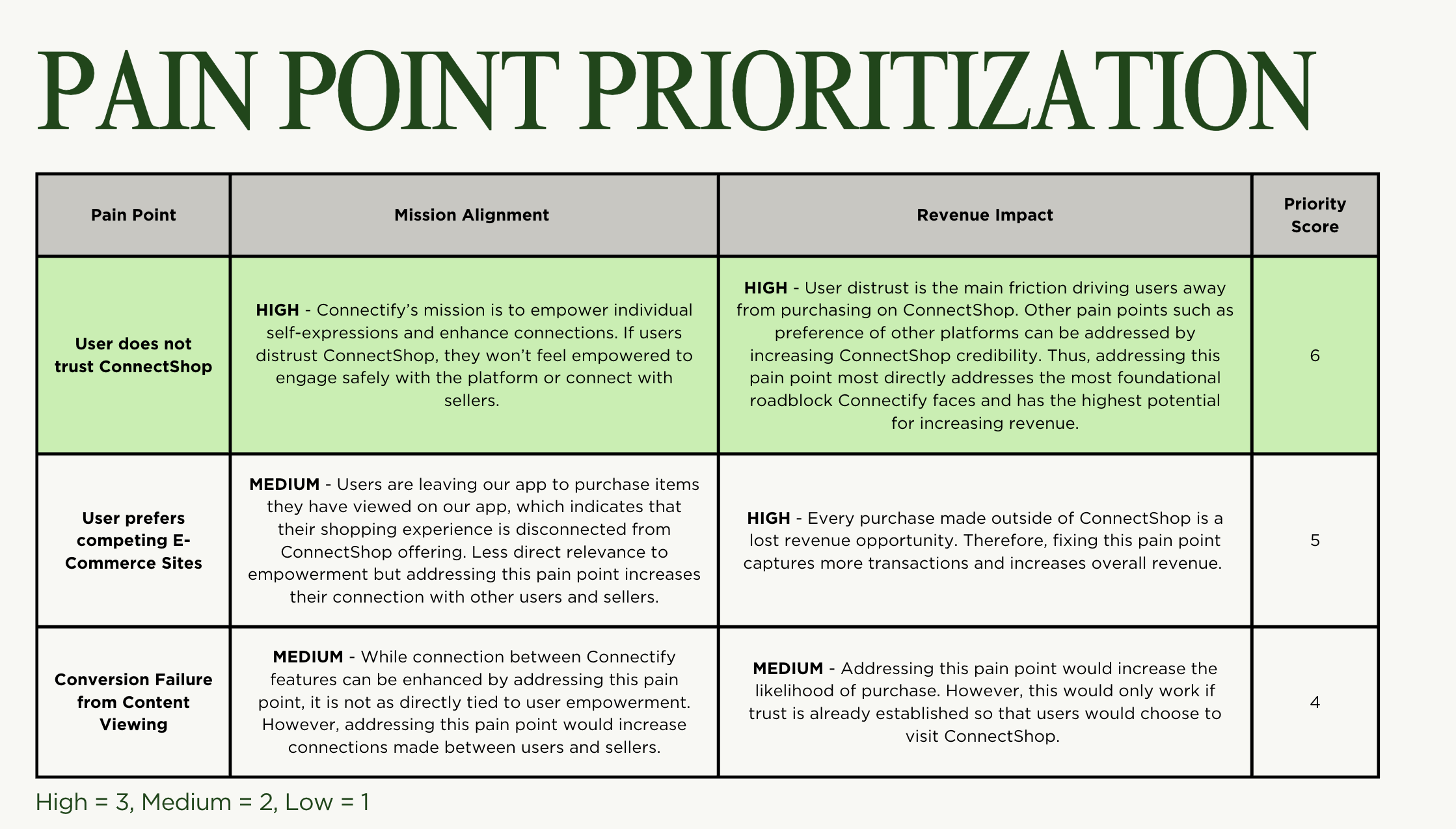

Left: Identifying core pain points.
Right: Selecting the Highest-Impact MVP.
Right: Selecting the Highest-Impact MVP.
MVP A/B Testing
We translated our highest-priority solution into a lightweight MVP focused on increasing trust and reducing friction in ConnectShop. Rather than redesigning the full commerce experience, we tested a targeted social-proof intervention — “Inspired by Your Mutuals” — aimed at increasing conversion among already high-engagement users.The feature surfaced peer-based signals directly in the feed, tagging select products with messaging such as: “Purchased by your friend(s)” or "Liked by people you follow.”
To evaluate impact, we conducted a controlled A/B test:
To evaluate impact, we conducted a controlled A/B test:
- Stay culturally relevant and socially connected
- Discover products aligned with trends and creator recommendations
- Make purchases that feel intentional and validated
- Avoid friction or uncertainty during checkout
This allowed us to isolate the behavioral impact of mutual-based social proof on user engagement while holding all other variables constant.
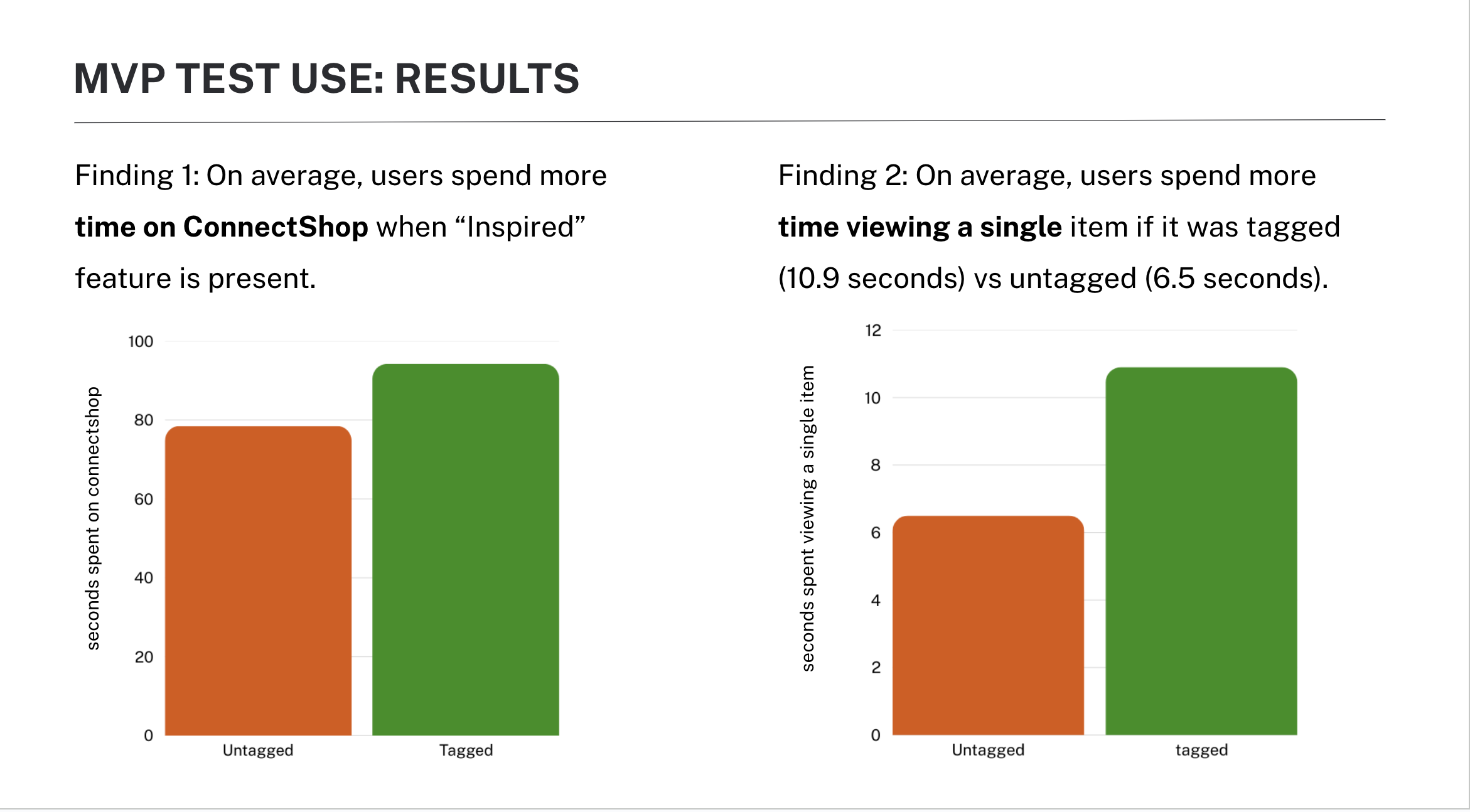

A/B test results showing increased engagement and conversion behavior when mutual-based social proof was present.
Final Presentation
The final solution focused on reducing behavioral friction at the moment of purchase by embedding social proof and trust signals directly into the shopping experience. By highlighting products purchased by mutual connections, verifying credible sellers, and incentivizing high-quality reviews, the solution increases confidence and encourages high-engagement users to convert without disrupting their existing browsing habits.

The final solution focused on reducing behavioral friction at the moment of purchase by embedding social proof and trust signals directly into the shopping experience. By highlighting products purchased by mutual connections, verifying credible sellers, and incentivizing high-quality reviews, the solution increases confidence and encourages high-engagement users to convert without disrupting their existing browsing habits.
Reflection
What did I learn working on this project?
This project strengthened my understanding of product management fundamentals beyond interface design. I learned how to define a measurable problem, align user pain points with business impact, prioritize solutions using structured frameworks, and validate hypotheses through lightweight experimentation.
Working through user segmentation, RICE scoring, MVP scoping, and A/B testing clarified how product decisions must balance user psychology, feasibility, and revenue outcomes — not just feature desirability.
Working through user segmentation, RICE scoring, MVP scoping, and A/B testing clarified how product decisions must balance user psychology, feasibility, and revenue outcomes — not just feature desirability.
What would I have done differently?
If this were a real product environment rather than a hypothetical platform, I would have conducted deeper competitive and behavioral research. Because Connectify was conceptual, we couldn’t directly test against real user ecosystems without benchmarking against platforms like TikTok or Instagram Shopping. This would strengthen the confidence of our prioritization and ground the solution in observed, not assumed, platform behavior.
How has this experience prepared me for my next project?
This project taught me how to translate qualitative insights into measurable outcomes — to turn themes like “lack of trust” into defined hypotheses, test them through controlled experiments, and use the results of those tests to guide future product direction. Rather than relying on intuition, I learned to anchor decisions in behavioral metrics and let data determine iteration.
It trained me to:
- Frame ambiguous problems into measurable hypotheses
- Prioritize based on impact, not just creativity
- Connect user psychology to business outcomes
- Design experiments that generate actionable data
This mindset directly translates to future PM or product design work, where the real challenge is identifying the highest-leverage friction point and designing the smallest testable intervention to move the metric that matters.