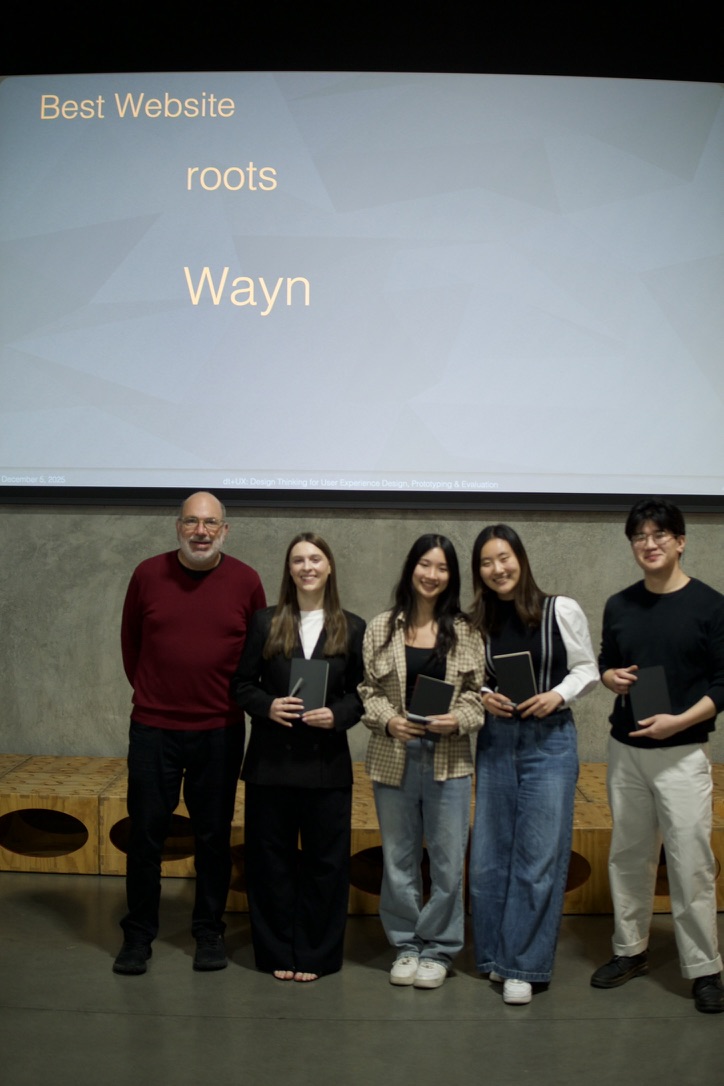
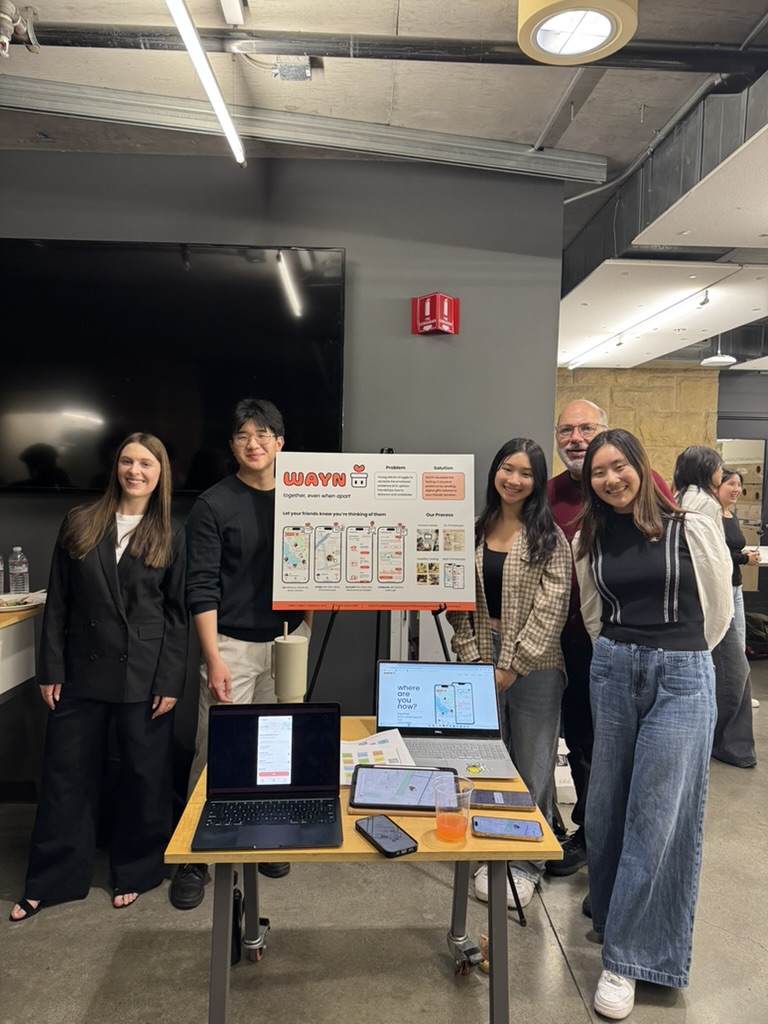
WAYN was developed through an end-to-end human-centered design process as part of Stanford’s CS147: Introduction to Human-Centered Design. Our team conducted in-depth field research on fulfillment and relationships in early adulthood, interviewing young adults across the Bay Area to understand how people maintain emotional closeness as their lives and locations begin to diverge. We synthesized these insights through empathy mapping, POVs, and experience prototypes, using real stories and behaviors to guide every design decision from early idea generation to a functional prototype.
Project Description
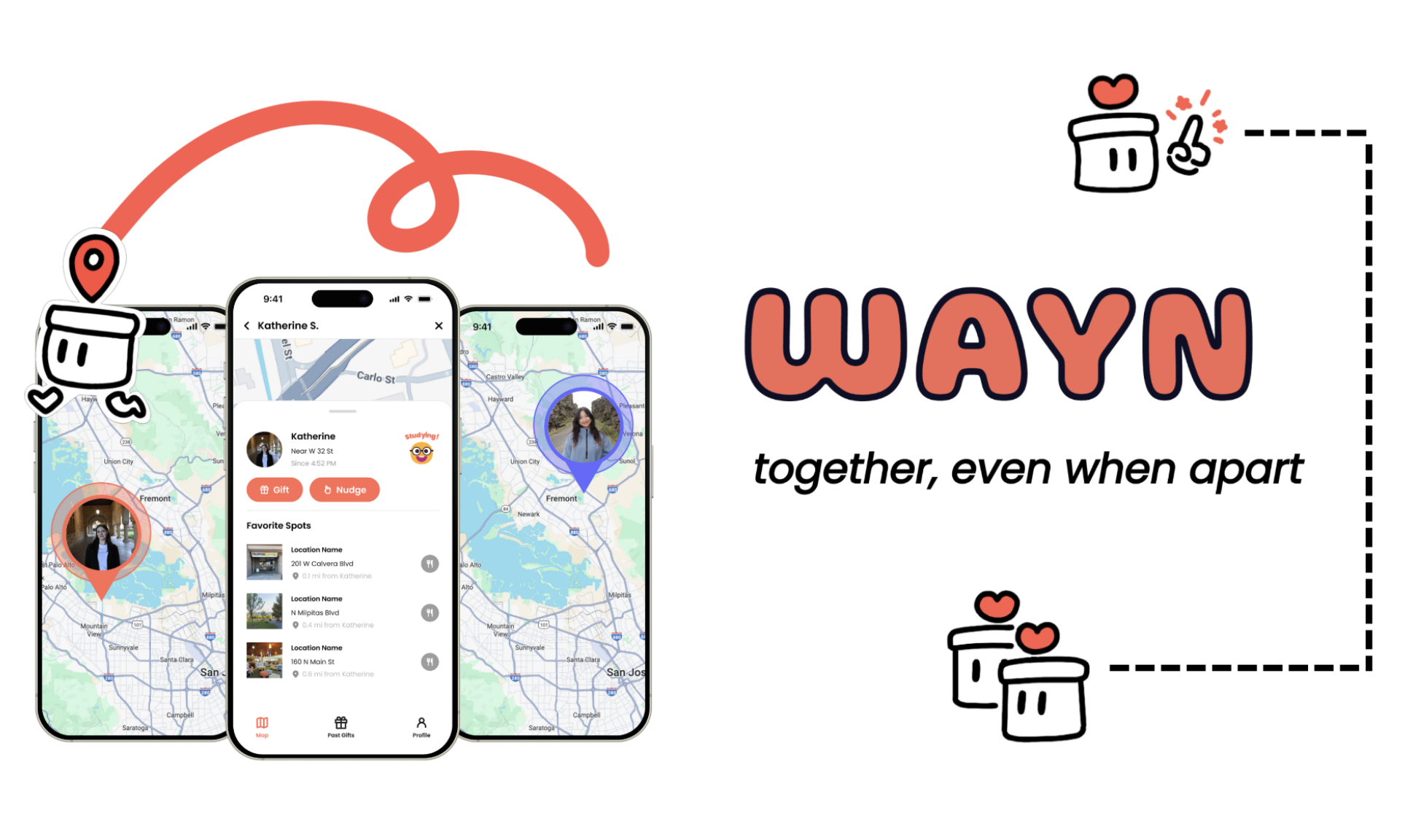
WAYN is a location-based social app that transforms where you are into moments of connection. By enabling friends to send thoughtful micro-gifts, notes, and prompts tied to physical places, WAYN makes staying emotionally close feel effortless—even when apart.
Team
Jillian Chang
Leo Sui
Hallie Xu
Leo Sui
Hallie Xu
Role
Product Designer
User Researcher
Product Manager
Website Design Lead
User Researcher
Product Manager
Website Design Lead
Duration
Sept - Dec 2025
About
Background
Problem
As young adults move out of school and into independent adulthood, their friendships become increasingly difficult to sustain. Physical distance, mismatched schedules, and new life paths make even strong relationships can quietly drift over time. Our interviews revealed that while people deeply value emotional connection, the tools they rely on today — texting, social media, and location sharing — fail to create the small, intentional moments that make people feel remembered and cared for.
Opportunity
Our research showed that what people miss most is not conversation — it’s presence. Small, thoughtful gestures tied to real life moments (a letter, a laugh, a shared memory, a surprise) are what make relationships feel alive. We saw an opportunity to use location — where someone is and what they’re doing — as a trigger for spontaneous, emotionally meaningful interactions that don’t require perfect timing or long conversations.
Interviews
Research Methodology
We conducted two rounds of qualitative interviews with young adults across the Bay Area — from recent graduates to service workers — to understand how people experience fulfillment and maintain friendships after leaving school. Early conversations revealed that relationships were the strongest driver of fulfillment, which led us to narrow our focus to long-distance and time-strained friendships.
We synthesized our findings through empathy maps, POV statements, and How-Might-We questions, then explored solutions through experience prototypes such as digital letters, playful interruptions, and guided friendship prompts. These prototypes allowed us to test emotional and behavioral assumptions before converging on our final product direction.
We synthesized our findings through empathy maps, POV statements, and How-Might-We questions, then explored solutions through experience prototypes such as digital letters, playful interruptions, and guided friendship prompts. These prototypes allowed us to test emotional and behavioral assumptions before converging on our final product direction.
Goal
The goal of our research was to understand how young adults maintain emotional closeness in friendships after leaving structured, academic environments like high school or university.
Specifically, we were interested in learning:
Specifically, we were interested in learning:
- How physical distance and changing schedules impact relationships
- What people do today to maintain closeness when they can’t be together
- What makes digital interactions feel meaningful vs. shallow
- What emotional tensions arise as friendships evolve in early adulthood
Personas
- Stephen — The Life-Transitioning Friend
- Sarah — The Emotionally Invested Friend
- Jenna — The Time Constrained Friend

Biography
Age: 26
Occupation: Software Engineer
Location: Bay Area
Stephen is early in his career and deeply curious about the world. He wants to explore new cities and pursue meaningful work in conservation, but feels anchored to the social circle he built in college. The idea of leaving his friends behind feels riskier than staying in a job that doesn’t fully fulfill him.
Occupation: Software Engineer
Location: Bay Area
Stephen is early in his career and deeply curious about the world. He wants to explore new cities and pursue meaningful work in conservation, but feels anchored to the social circle he built in college. The idea of leaving his friends behind feels riskier than staying in a job that doesn’t fully fulfill him.
Goals
- Pursue meaningful career opportunities
- Explore new places and communities
- Maintain emotional closeness with his core friends
Needs
- Reassurance that distance doesn’t mean disconnection
- Ways to bring his existing friendships into new life chapters
- Emotional support while entering unfamiliar social environments
Pain Points
- Fear of losing friendships when moving
- Emotional isolation when entering new social settings
- Feeling like he must choose between ambition and belonging
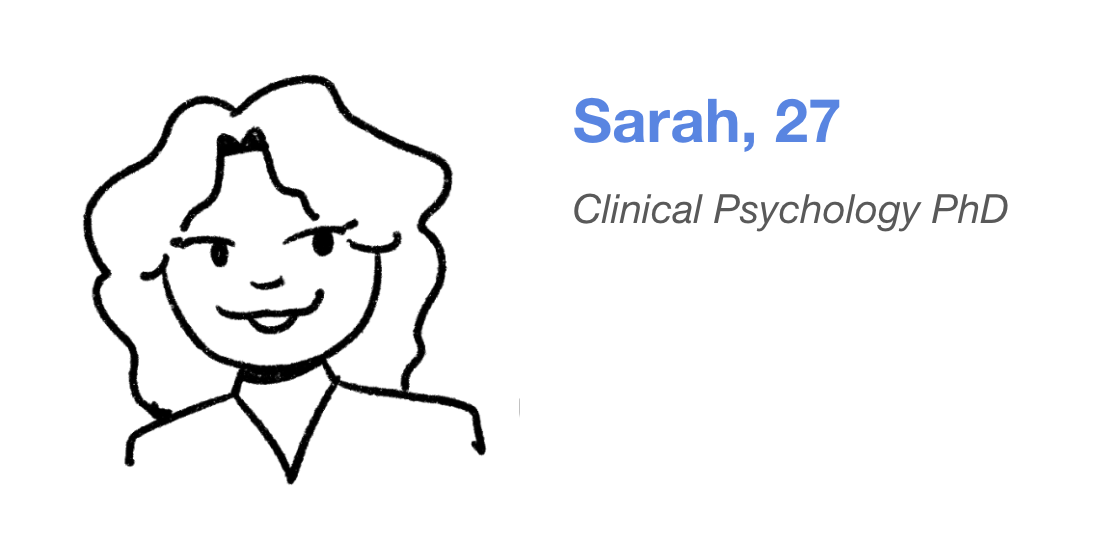
Biography
Age: 27
Occupation: Clinical Psycholgy PhD
Location: Bay Area (recently from New York City)
Sarah deeply values her long-term friendships, but as her life becomes busier and more demanding, she feels pressure to live up to old expectations. While she enjoys the lightness of newer friendships, her deepest emotional support still comes from people who know her history.
Occupation: Clinical Psycholgy PhD
Location: Bay Area (recently from New York City)
Sarah deeply values her long-term friendships, but as her life becomes busier and more demanding, she feels pressure to live up to old expectations. While she enjoys the lightness of newer friendships, her deepest emotional support still comes from people who know her history.
Goals
- Maintain meaningful long-term friendships
- Avoid guilt and emotional overload
- Feel understood as her priorities shift
Needs
- Tools for communicating changing availability
- Ways to stay emotionally connected without constant effort
- Permission to evolve without losing touch with friends
Pain Points
- Guilt when she can’t show up the way she used to
- Anxiety around disappointing friends
- Emotional fatigue from trying to keep everyone satisfied

Biography
Age: 23
Occupation: Nail and Beauty Technician
Location: San Jose
Jenna thrives on warmth, laughter, and shared experiences, but her rigid work schedule leaves little room for spontaneous meetups. She relies on social media to stay in touch, even though it doesn’t fully satisfy her need for closeness.
Occupation: Nail and Beauty Technician
Location: San Jose
Jenna thrives on warmth, laughter, and shared experiences, but her rigid work schedule leaves little room for spontaneous meetups. She relies on social media to stay in touch, even though it doesn’t fully satisfy her need for closeness.
Goals
- Feel emotionally connected to her friends
- Maintain her social circle despite limited free time
- Experience joy and shared moments
Needs
- Time-flexible ways to connect
- Emotional richness without needing to be physically present
- Low-effort, high-impact interactions
Pain Points
- Feeling disconnected despite being socially active
- Missing out on shared experiences
- Digital communication that feels shallow
Challenge
After synthesizing our interviews into three relationship archetypes — the New-Chapter Friend, the Emotionally Invested Friend, and the Time-Constrained Friend — we translated their core tensions into How Might We statements.
Each HMW reframes a real, observed struggle into a designable opportunity. Rather than describing features, they articulate what must change in order for emotionally meaningful friendships to survive distance, time, and life transitions.
These three HMWs represent the primary emotional and behavioral barriers we needed to solve for.
Each HMW reframes a real, observed struggle into a designable opportunity. Rather than describing features, they articulate what must change in order for emotionally meaningful friendships to survive distance, time, and life transitions.
These three HMWs represent the primary emotional and behavioral barriers we needed to solve for.
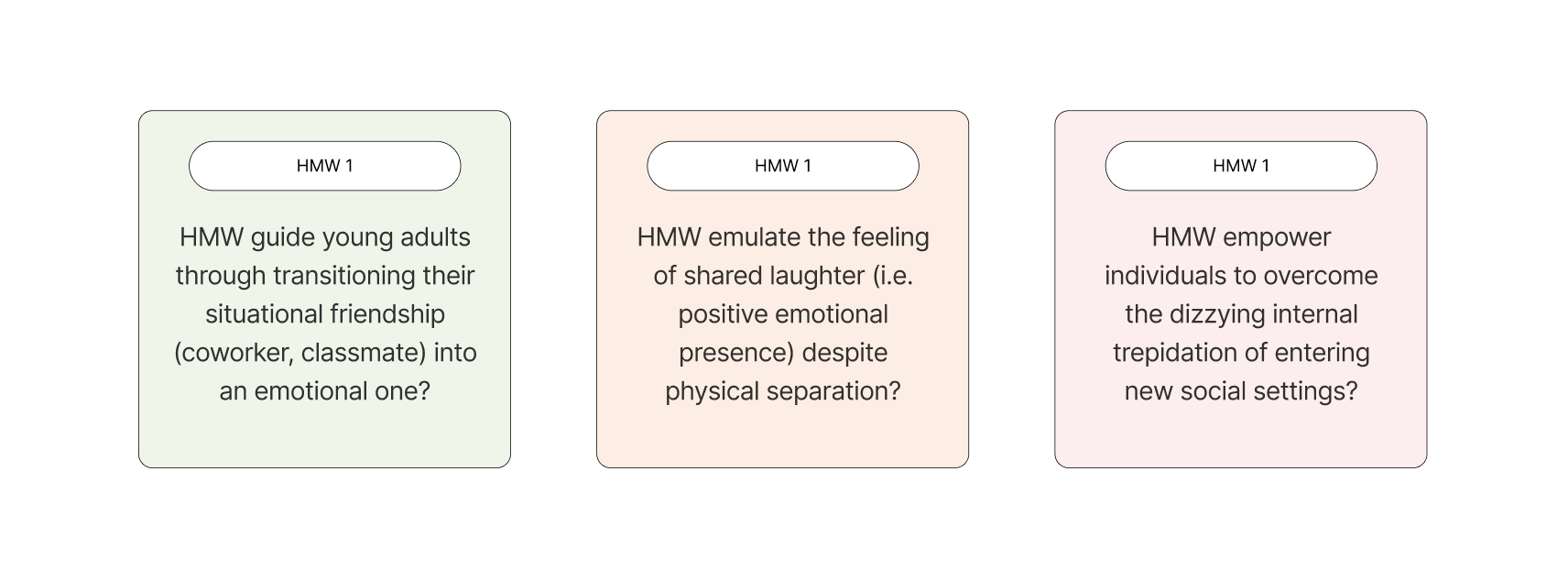
Above: These three How-Might-We statements represent the core emotional and behavioral tensions we needed to solve for across all three relationship archetypes.
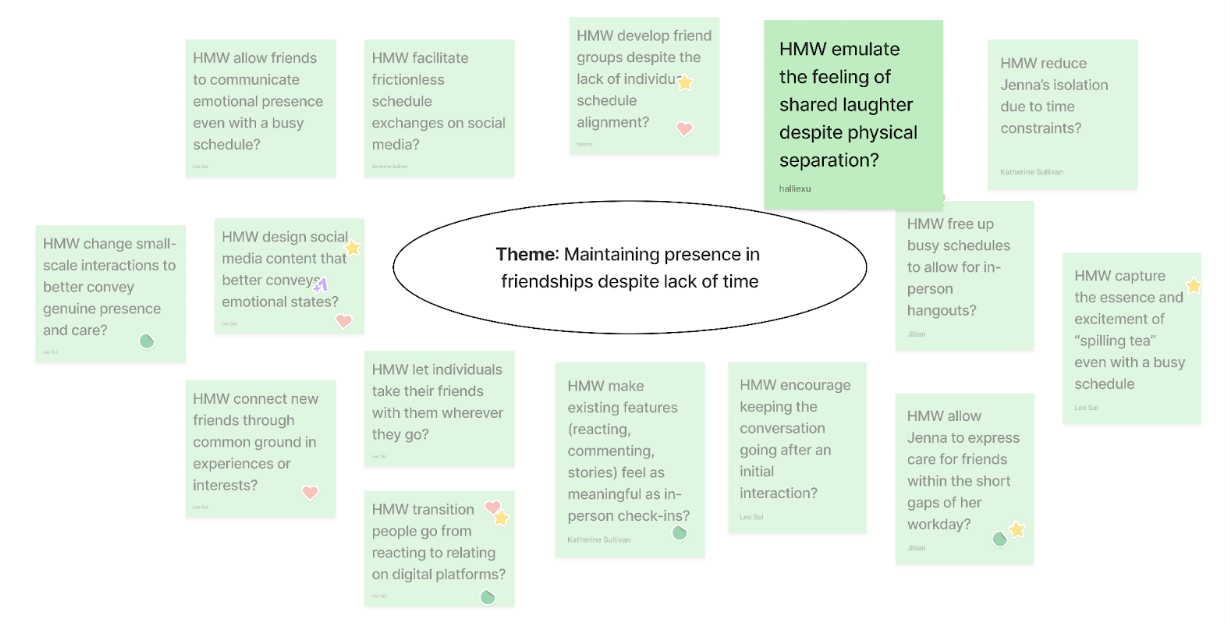
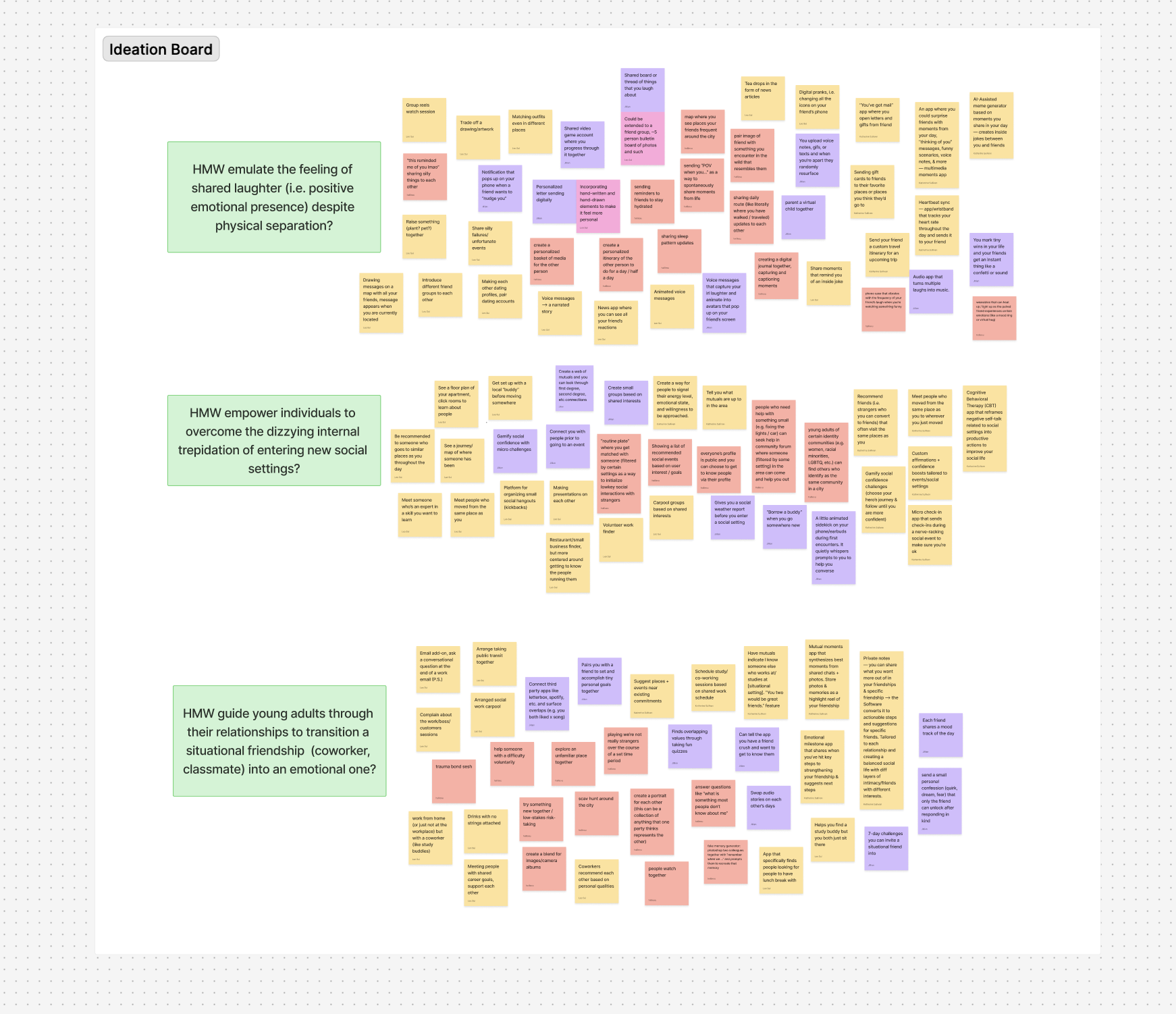
Left: Translating interview themes into How-Might-We questions.
Right: Ideation across each HMW, exploring multiple directions before narrowing down our solutions.
Right: Ideation across each HMW, exploring multiple directions before narrowing down our solutions.
Experience Prototypes
Because WAYN is about emotional presence — not just interface flows — we needed to validate how people would feel when using different kinds of interactions. Rather than jumping straight into screens, we built experience prototypes to test the emotional and behavioral assumptions behind each concept before committing to a single direction.
Each of our three HMWs pointed to a fundamentally different way of creating connection. To avoid prematurely locking into one model, we selected three concept directions that were emotionally distinct:
1) Reflective connection (digital letters)
2) Playful shared moments (digital pranks)
3) Structured relationship support (friendship counselor)
These three prototypes allowed us to compare which interaction styles actually generated warmth, presence, and follow-through — not just which sounded good on paper. The results directly informed which direction we refined into WAYN.
Each of our three HMWs pointed to a fundamentally different way of creating connection. To avoid prematurely locking into one model, we selected three concept directions that were emotionally distinct:
1) Reflective connection (digital letters)
2) Playful shared moments (digital pranks)
3) Structured relationship support (friendship counselor)
These three prototypes allowed us to compare which interaction styles actually generated warmth, presence, and follow-through — not just which sounded good on paper. The results directly informed which direction we refined into WAYN.
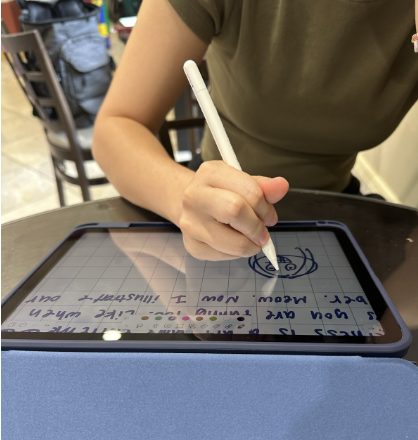
Digital Letters: Sender writes the digital letter sent to a friend, and the friend then reports to us how the digital letter made them feel.
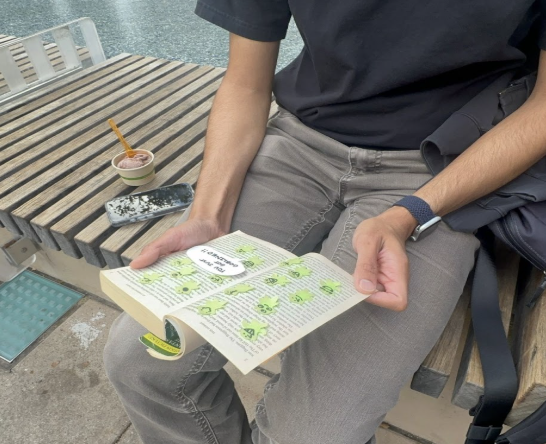
Digital Pranks: Participant is asked to read a book. Their reading flow is interrupted by a page of goblin stickers, mimicking the surprise of an unexpected prank.
Together, these prototypes exposed a tradeoff between intimacy, effort, and frequency:
1) Digital Letters created deep emotional intimacy, but required too much time and intention to support frequent, everyday connection.
2) Digital Pranks sparked joy and shared laughter, but could become disruptive or unwelcome without sensitivity to context.
3) The Friendship Counselor surfaced meaningful insights, but felt heavy and lacked the urgency needed to turn reflection into action.
These tensions revealed a clear design gap: people wanted to feel emotionally present for their friends in real life moments, without having to schedule, write, or interrupt them.
This led us to WAYN — a location-based social app that uses where someone is to create spontaneous, thoughtful moments of connection. By tying gifts, audio, and notes to real-world places, WAYN makes it easy to say “I'm thinking of you” in ways that feel natural, timely, and emotionally meaningful.
1) Digital Letters created deep emotional intimacy, but required too much time and intention to support frequent, everyday connection.
2) Digital Pranks sparked joy and shared laughter, but could become disruptive or unwelcome without sensitivity to context.
3) The Friendship Counselor surfaced meaningful insights, but felt heavy and lacked the urgency needed to turn reflection into action.
These tensions revealed a clear design gap: people wanted to feel emotionally present for their friends in real life moments, without having to schedule, write, or interrupt them.
This led us to WAYN — a location-based social app that uses where someone is to create spontaneous, thoughtful moments of connection. By tying gifts, audio, and notes to real-world places, WAYN makes it easy to say “I'm thinking of you” in ways that feel natural, timely, and emotionally meaningful.
Flows
Simple Task — Nudges
The simple flow allows users to see their friends on a map and send a nudge — a lightweight, real-time signal that says “I’m thinking of you.” Nudges are designed to maintain emotional presence without requiring conversation, scheduling, or emotional effort. By turning passive location-sharing into an active gesture, this flow keeps relationships alive through small, frequent moments of acknowledgment, helping friends feel seen even on their busiest days.
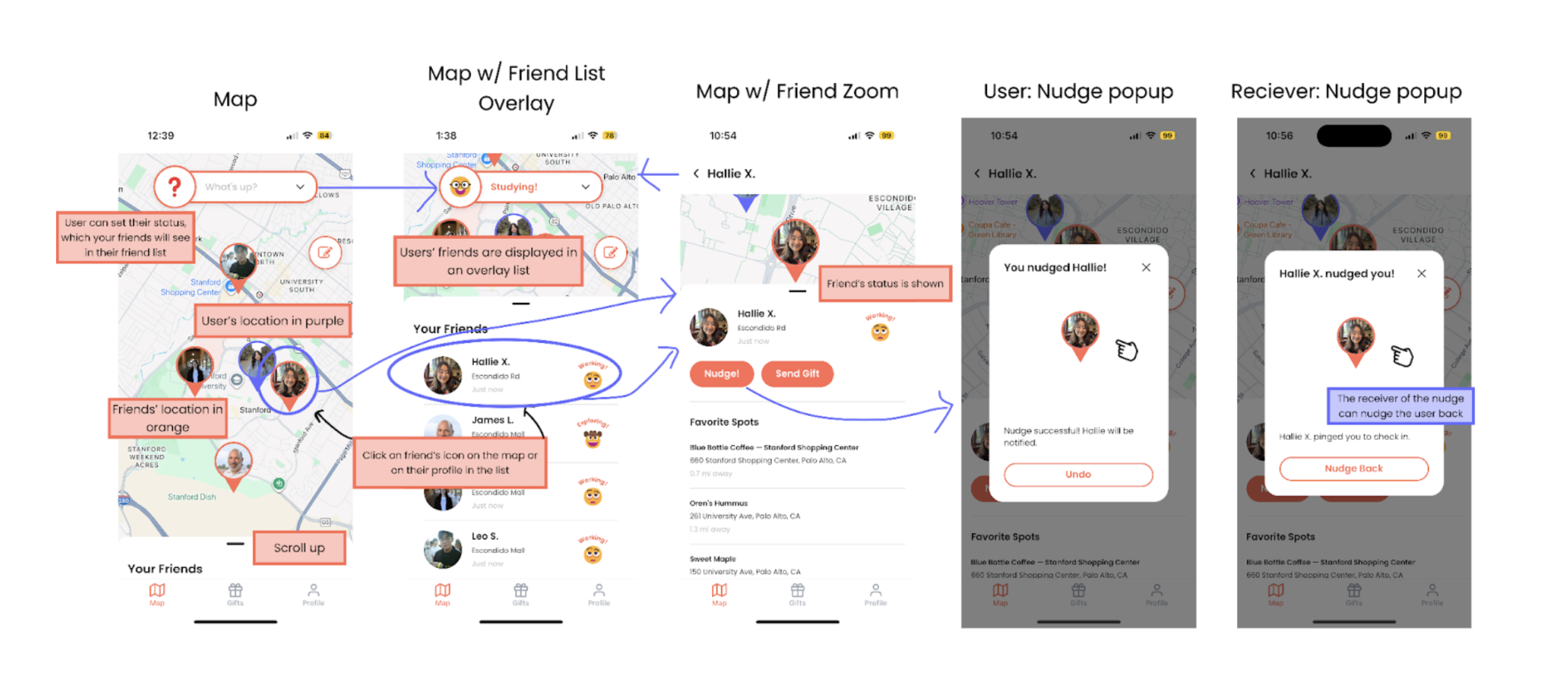
Above: Final Interface for Simple Task
Medium Flow — Location-Based Gifts
The medium flow lets users send multimodal gifts — such as letters, playlists, audio messages, or digital gift cards — that are tied to a friend’s physical location. A gift might unlock when someone arrives at a café, finishes studying at the library, or visits a favorite spot. By grounding each gesture in real-world context, this flow transforms thoughtful gift-giving into something spontaneous and emotionally resonant, allowing users to show care without needing to coordinate time or write long messages.

Above: Final interface of medium task (letter and gift flows)
Complex Flow — Collaborative Gifts
The complex flow enables groups of friends to collaborate on a single shared gift, combining messages, media, and surprises into one experience. This allows multiple people to show up together for someone — whether to celebrate, encourage, or mark an important moment — even when they are physically apart. By supporting collective expression, this flow recreates the feeling of being surrounded by a community, strengthening not just one-to-one bonds but the broader social fabric around each user.
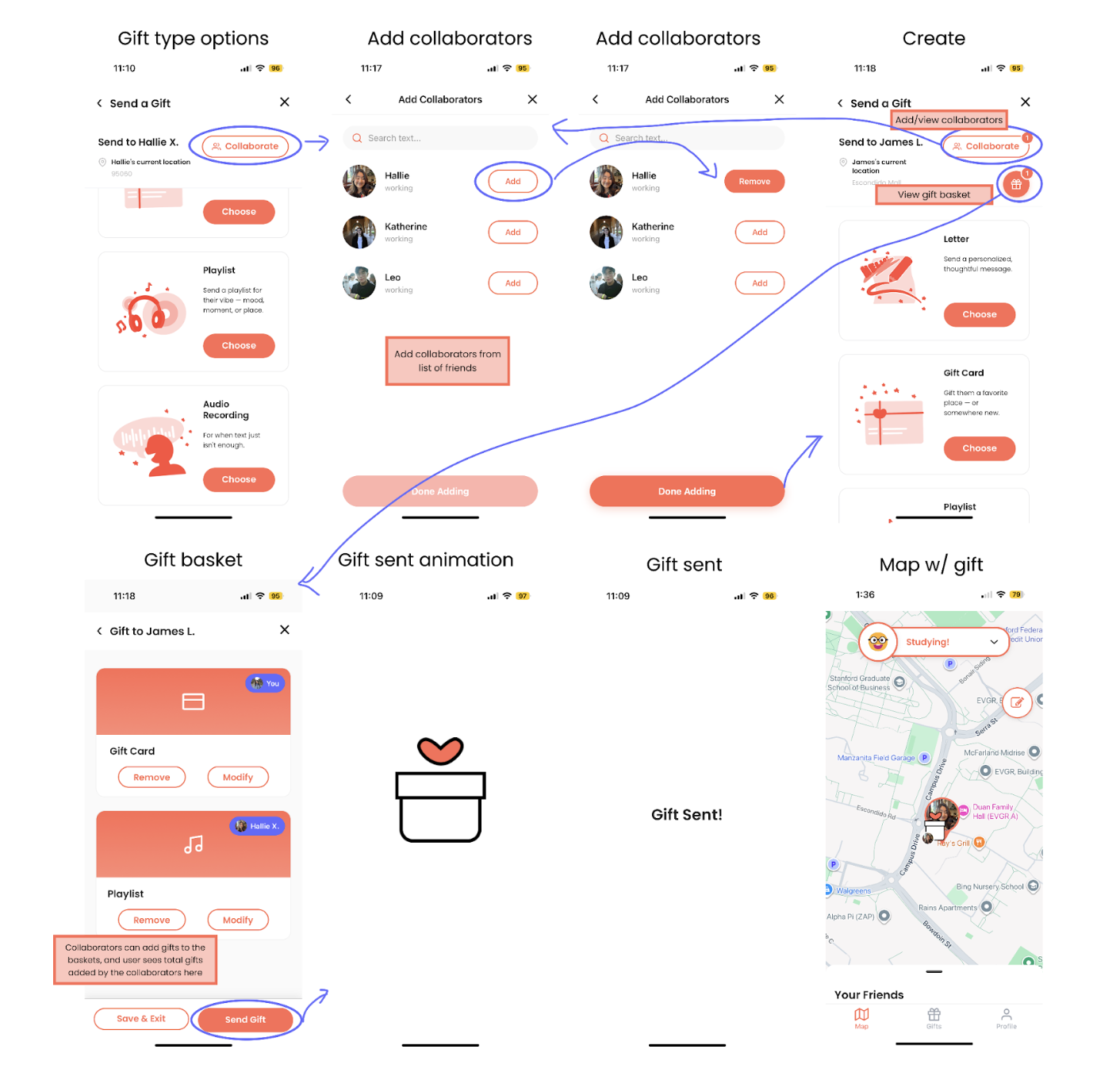
Above: Final interface of complex task (collaboration flow)
Demo
Reflection
What did I learn working on this project?
I learned how to translate qualitative user insights into cohesive product experiences — turning emotional needs like feeling remembered or supported into concrete flows, interactions, and visuals. Through WAYN, I also gained experience building and applying a design system, creating consistent components, visual language, and interaction patterns across a complex, multi-modal product. This helped ensure that features like letters, playlists, audio, nudges, and map interactions all felt like parts of one unified experience.
What would I have done differently?
Because of the structure and timeline of CS147, we weren’t able to deploy our high-fidelity prototype for real-world use. Our final flows were tested through in-section usability sessions and evaluated through heuristic reviews by design peers and experts, which helped us refine clarity, accessibility, and interaction quality.
If we had more time, I would have taken WAYN into the field — letting real friends use it over days or weeks — to observe how meaningful connection, novelty, and friction play out in everyday life. That kind of longitudinal testing would have allowed us to validate not just whether the product was usable, but whether it truly became part of how people maintain relationships.
If we had more time, I would have taken WAYN into the field — letting real friends use it over days or weeks — to observe how meaningful connection, novelty, and friction play out in everyday life. That kind of longitudinal testing would have allowed us to validate not just whether the product was usable, but whether it truly became part of how people maintain relationships.
How has this experience prepared me for my next project?
This project gave me a strong foundation in end-to-end product design. I now feel confident moving from research to synthesis to prototyping to visual and interaction design, and using testing at each stage to guide decisions. It also taught me how to work within real constraints — time, technical limits, and incomplete data — while still producing a thoughtful, user-grounded product direction. These skills directly carry into any future design or product work I take on.